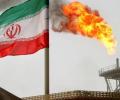
Indian Ambassador to the US Harsh Vardhan Shringla said India has stopped importing oil from Iran after the United States refused to extend exemption from sanctions earlier this month.

Describing Rana as a flight risk, the US government opposed his release on bail, arguing that if he were to flee to Canada, he may escape the possibility of a death sentence in India.
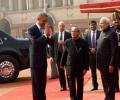
'We are no longer striving for a strategic partnership. We have arrived at one.'

"Fifteen years ago, I was leading the efforts to approve the historic civil nuclear deal with India. I said that if the US and India became closer friends and partners, then the world will be a safer place," Biden, who was vice-president in the Obama administration, said while addressing the Indian-American community on India's Independence Day.

'If there were no Ahmedabad programme -- no flashy town hall event in a huge cricket stadium with thousands cheering him on -- then Trump may well have decided not to go to India.'
Wisner said during a discussion organised by Asia Society here yesterday on the Indian elections.

Ignoring the United States viewpoint, India has refused to consider the Devyani Khobragade episode as "closed", saying there are "residual" issues which need to be addressed.

'Surely, Syrian President Bashar al-Assad will not be able to pay or compensate the Russians for deployment and use of Russian men and equipment,' says Brigadier S K Chatterji (retd).

Prime Minister Narendra Modi on Wednesday arrived in Frankfurt en route to New Delhi after concluding his visit to the US where he met President Barack Obama and agreed to make joint efforts to dismantle terrorist safe havens besides stepping up cooperation in defence, energy, economy and space.
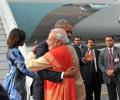
'A three generation US-Pakistan relationship is not likely to be snapped any time soon. All this presents an irritant to an India that wishes to concentrate on economic development,' says Colonel Anil A Athale (retd).

The new equation between 'Namo' and 'Barack' may well 'convert a good start into lasting progress.'

The India-Japan joint naval exercises are a strategic signal for China, observes Dr Rajaram Panda.

Jaishankar said that the resolution on Kashmir introduced by Jayapal in the House is not a fair characterisation of the situation in J-K. And also said that he has no interest in meeting the Congresswoman.

Modi and Trump will meet at 1.20 am (IST) following which they will have delegation talks and then a dinner.

Ashley J Tellis, a leading authority on Indo-US relations, tells Archis Mohan in an emailed interview that it is time Washington and New Delhi agreed on the contours of their 'strategic partnership', and that India's elite could learn from Prime Minister Narendra Modi in how he has put India's interests first and his own sentiments about the Americans second.

Reflecting the strong bipartisan support to the India-US relationship, the lawmakers welcomed the decision of the House Speaker Paul Ryan to invite Modi to address the joint meeting.

Prime Minister Narendra Modi's address to a joint meeting of the United States Congress will be an opportunity to energise efforts to improve bilateral ties, top American lawmakers from across the political divide have said.
'We don't want confrontation; we are trying to build a cooperative relationship in which both sides have stakes in producing an improving climate of relations and responsible behaviour.' What does Shiv Shankar Menon, one of India's most brilliant diplomats and the former National Security Advisor, think of the Modi visit to the US, the Chinese stand-off in Ladakh and the situation on the LoC?
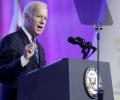
While inaugurating the leadership summit of the US-India Business Council in Washington, DC, US Vice President Joe Biden said that there was no reason why the two largest democracies in the world should not continue to have a more productive relationship. Aziz Haniffa/ Rediff.com reports.

'I am hopeful that you will see more focused attention on this relationship,' former US assistant secretary of state Nisha Desai Biswal tells Alokananda Chakraborty.
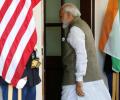
We see none of the euphoric build-up customary to India's encounter with US presidents in recent times. This gives Modi wriggle room to work on the much-needed reset of India-US ties.

Upset over the Devyani Khobragade episode, India on Wednesday raised with the United States its concerns over "trafficking" visas issued to family members of Sangita Richard, the absconding maid of the Indian diplomat whose arrest had triggered a row between the two countries.

'If the US-Pakistan relationship continues to suffer, Pakistan may feel it has less to lose and decide that it need not keep a leash on LeT in order to appease America.' 'A tougher US policy toward Pakistan could lead to an emboldened and strengthened LeT and JeM, resulting in more terrorist attacks in India.'

Strategic consideration were the reasons behind frequent meetings between United States President Barack Obama and Prime Minister Narendra Modi, Chinese state-run media said on Wednesday and cautioned India that it cannot rise by "containing" China or picking one side against the other.

His view will be shaped by his perception of US world interests and India's economic performance relative to China.
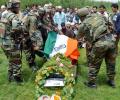
'Fighting terrorism and doing away with the safe shelters, sanctuaries, and safe havens will be an important part of our cooperation.'

'There is little appetite in the Democratic foreign policy establishment to pick a fight with India.'
Led by Ajay Shriram, chairman and senior managing director, DCM Shriram, the CEO's delegation seeks to convey to their American counterparts the sense of optimism amongst Indian industry.

India's unusual tough stand on the arrest of its diplomat Devyani Khobragade has forced the United States to initiate an "inter-agency review" to look into the lapses that happened in the high-profile case that triggered an uproar in India and strained bilateral ties.
'By his very presence in Delhi on Republic Day, Obama is revisiting the most defining relationship of the 20th century after a period of stagnation,' says Ambassador T P Sreenivasan.

Narendra Modi's positive engagement with Barack Obama has well and truly washed away the doubts and slights of the past.

Recognising the threat posed by outfits like the Al Qaeda, Lashkar-e-Tayiba and the Dawood Ibrahim network, India and the United States have agreed to deepen cooperation in fighting terrorism and asked Pakistan to bring to justice the 2008 Mumbai attack perpetrators.

'I could see it not having any impact whatsoever,' says Stephen P Cohen on Obama's India visit.

With an intent of deepening the bilateral strategic partnership, Prime Minister Manmohan Singh has arrived in Washington for a Summit meeting with President Barack Obama, saying that India needs US on its side at a time when added thrust is being given to developmental programmes back home.
'If push comes to shove, Pakistan does have the capability to make it difficult for the US and NATO forces to make even a withdrawal of troops out of Afghanistan in orderly fashion,' says Ambassador M K Bhadrakumar.

The perfunctory management of external affairs has left India's foreign policy establishment largely unprepared to manage the consequences of dramatic international developments, says Nitin Pai.

In the first official visit by a United States vice-president to India in three decades, Joe Biden arrived in India on Monday on a four-day tour aimed at boosting ties in key areas of trade, energy, defence and security. The US vice-president will hold meetings with top Indian leadership, including President Pranab Mukherjee and Prime Minister Manmohan Singh, on Tuesday before flying out to Mumbai in the night.

The two PMs called upon all countries to work towards rooting out terrorist safe havens and infrastructure.

Narendra Modi and Barack Obama will ponder over ties twice over, says Nayanima Basu

'This is the first time that the Americans have agreed to refer to "cross-border terrorist attacks" in a joint statement.' 'No wonder Pakistan has called the joint statement "singularly unhelpful" and has blasted it, and its all-weather friend China has applauded Pakistan's frontline role in combating terrorism,' points out former foreign secretary Ambassador Kanwal Sibal.
